Every time a new Dave’s Hot Chicken restaurant opens, the Los Angeles-based artists Arthur Akopyan and Haibert Sarkisian get a flood of interest on their social media pages from people who want to buy their artwork.
That’s because each restaurant is a canvas for the duo.
Akopyan and Sarkisian are the mad geniuses behind the colorful, graffiti-inspired murals that have become a distinctive visual signature for the fast-growing chicken chain. Since the first Dave’s unit opened in 2017, the two artists have created the artwork that covers the walls, ceilings and exteriors for every single restaurant. The chain is expected to reach 275 units by the end of the year, and most have been painted by Akopyan and Sarkisian personally. There are no two alike, and their signatures (and social media links) can be found on a wall at every unit.
“It puts eyes on our work on a daily basis,” said Akopyan. “The chain definitely gives us a lot of exposure.”
It’s also one example of the growing symbiotic relationship between American fast-food restaurants and contemporary art.
Probably from the earliest days of drawings on cave walls, food has been a theme for artists. And the rise of pop art in this country has coincided with the culture of fast food, so it’s no surprise to see modern work that pulls in echoes of Golden Arches or other familiar restaurant branding elements.
But restaurant marketing teams are increasingly tapping the creative skills of artists in new and unique ways—partnerships that have been paying off for both the restaurant brands and the artists.
And, in some cases, it has also paid off for would-be art “thieves,” or at least savvy dumpster divers who can recognize art from restaurants that could have value on secondary markets.
Consider the story of Mark Smith, who in 2003 was commissioned by Taco Bell to create three paintings that would be used in restaurants as art, according to a recent report in SF Gate, rather than the typical branded messaging that has long been what diners typically see on restaurant walls.
The three paintings, which have been described as in the style of Jean-Michel Basquiat, were sold to the Irvine, California-based chain, along with the intellectual property rights. Smith went on to build a career as an artist and the Taco Bell pieces were largely forgotten.
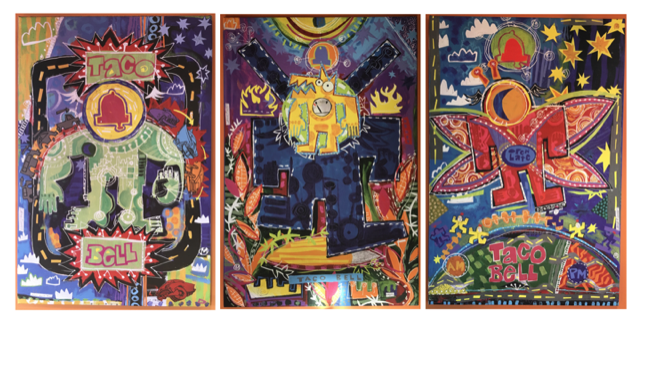
But then, the prints began disappearing from the restaurants, in what was believed to be theft. Police pledged to “search every dorm room and rumpus room,” but the prints were never found.
At least not until they started showing up on Ebay with bids reaching $10,000.
In the report, one seller (with apparently a good eye for art) said he got the prints from a Taco Bell that had been renovated and had trashed the artwork.
Trash to treasure
Neal Sherman, founder and CEO of restaurant liquidation firm TAGeX Brands, sees that notion of one person’s trash being another’s treasure play out every day.
His firm handles the resale of pretty much everything inside a restaurant after it closes or undergoes renovation, and that includes the décor.
TAGeX, for example, handled the liquidation of 48 Red Lobster units earlier this year prior to bankruptcy. There were buyers who wanted all of the décor and memorabilia, from plateware and signage, to the lobster tanks, though the deal moved too quickly for TAGeX to take advantage of that specific category of demand. The content of each restaurant was sold in lots.
A quick look through eBay indicates that some items from that sale are making their way to the secondary market. Listings popping up on eBay include a Crabfest menu (starting bid $22.98), a lobster shell cracker ($19.99) and even a vintage employee name tag pin ($7.49), for example. Oh, and this one-of-a-kind raised art piece is listed for nearly $80,000.
For many buyers, it’s not about collecting items that could be resold as art. Rather, fans have a sentimental connection to the brand that they want to keep as their own, Sherman said.
Sherman has seen this happen over and over with all kinds of restaurants.
Rob Grimes, CEO of the International Food and Beverage Technology Association (IFBTA) once bought a life-sized Bob’s Big Boy statue in a TAGeX auction to keep in his office, for example. (And he’s not alone. Big Boy statues can garner a pretty price on eBay.)

Rob Grimes with his Big Boy purchase. Photo courtesy of Neal Sherman.
When the once-iconic steakhouse Pacific Dining Car closed after more than 100 years of operation in Los Angeles in 2020, there was a frenzy of buying bits and pieces of the restaurant, from vintage cash registers to booths.
Hollywood actor/director Benicio del Toro, for example, paid “thousands” for what Sherman described as a “piece of shit hostess stand,” just because del Toro had signed his first movie deal at the restaurant.
Whataburger’s Museum of Art
Of course, diners who are fans don’t always wait until a restaurant closes before they take a piece for themselves.
At San Antonio, Texas-based Whataburger, for example, the plastic table tents are routinely going missing and finding their way into people’s homes (or being sold on eBay).

Whataburger’s iconic plastic table tents are regularly nicked by guests. Photo courtesy of Whataburger
Davis Alcorn, social experience manager for the brand, said he isn’t exactly “pro table-tent stealing,” but it’s accepted “with a nod and a wink.”
There’s just something nostalgic about the look of the table tents, or perhaps there’s something significant about the number that gives people sticky fingers, he said.
Seeing that passion for the brand inspired Whataburger in 2021 to launch a Museum of Art, which is now an Instagram page, but Alcorn hopes to someday find a physical museum for the collection. It was first planned as a physical museum before the pandemic squashed those plans, Alcorn said.
Now Whataburger pays artists to feature their work on the site. Some art is commissioned by the chain, but the artists can also feature pieces they create to sell (so long as it’s Whataburger themed).
“It’s a way to reach communities we don’t necessarily talk to on a day-to-day basis,” said Alcorn. But it’s also a way to celebrate artists with certain themes, like Black History Month or Hispanic Heritage Month.
“We’re hoping all these artists find it leads to more exposure to their work,” he said.
Catching eyes
That has certainly been true for Dave’s Hot Chicken artists Akopyan (known as Splatter Haus) and Sarkisian (who goes by Dehmq). Both now work with a number of restaurants, like Rouge, among a host of other vehicles for their work, from tattoos to shoes.
Akopyan and Sarkisian always do the design. Sometimes their crew (Valyou Inc.) does the actual painting, but the duo still do about 80% of installs, they said.
Here’s a video showing the two artists at work:
“We get a lot of people hitting us up after every (Dave’s) install that want to buy a piece, or merch, or they hire us to do their homes,” said Akopyan.
They describe their work as playful. There are running themes, like evoking elements of outer space or aliens (because “Dave’s is out of this world”), and each restaurant has the character Dave (the chicken) in various costumes, for which the two develop slogans.
There’s Dave as a hockey player (“Heat that slaps.”) or Dave as investment banker in suit and tie (“Get rich or die frying.”)
It’s art that is not inexpensive for franchisees, though Akopyan declined to give specifics on cost.
But it is an investment that pays off.
Jim Bitticks, Dave’s president and a franchisee himself, said the company has found that units with the most eye-catching exterior murals by the two artists tend to show higher sales averages.
“It’s partly curiosity. It drives people in to see the space,” said Akopyan.
Now some franchise operators are going beyond and asking the two artists to do commissioned pieces as a reward for employees, for example. After an install in Oregon, one franchise operator asked them to do special canvases for each team member to take home.
“We’ve really seen demand for this go up,” Akopyan added. “Now it’s not only Dave’s, but Burger King, Del Taco. A lot of people are bringing this kind of work into their mix. I think the art world is getting really heavily integrated into the franchise world, for sure.”