
This is the third story in Restaurant Business' weeklong series marking the fifth anniversary of the pandemic on the restaurant industry.
Tim McEnery knew the world had changed when his dad started using DoorDash.
The father of the Cooper’s Hawk Winery and Restaurants founder had always been the type to call the pizza place, put in his order and drive there to pick it up himself.
Then the pandemic hit, forcing many Americans to take shelter at home in an effort to slow the spread of COVID-19.
Dining at a restaurant was off limits in those early days, and grocery stores were risky at best. For the first time, many people, like McEnery’s dad, turned to third-party delivery services to get their food.
“He learned how to use DoorDash, and my stepmom learned how to use the grocery app,” McEnery said. “It was such an accelerated introduction to DoorDash, Grubhub, Uber Eats.”
That rapid introduction was happening to restaurants as well, including McEnery’s. The upscale, wine-centric Cooper’s Hawk had never planned to offer delivery. But when the chain had to close all of its dining rooms and let go of much of its staff at the start of COVID, it launched delivery in four days.
The sudden surge in supply and demand for food delivery changed the restaurant business almost overnight. Delivery sales doubled in the first three months of the pandemic, to $3.8 billion, from $1.9 billion in the three months leading up to it, according to the USDA. By the end of the year, revenues for DoorDash and Uber Eats had more than tripled compared to 2019.
Delivery would continue on this trajectory until the summer of 2021, when COVID restrictions eased and on-premise dining began to return. Observers wondered just how sticky delivery would be as the world settled into a new normal. But it never fully came back to earth. As of 2024, delivery accounted for 12% of all restaurant sales, up from 7% in 2019, according to Technomic data.
Today, though still relatively small, delivery is something few restaurants can afford to ignore. More than 40% of consumers now consider restaurant delivery to be an essential part of their lifestyle, including roughly 65% of Gen Zers and millennials, according to the National Restaurant Association’s 2025 state of the industry report. And 82% of people said they’d order delivery more often if they could afford it.
Cooper's Hawk ended delivery when people started returning to its restaurants in person. But it began offering it again a few months ago after determining that many consumers prefer it.
“Just because we want people to come to the restaurant, we shouldn't preclude them from being able to get food in their home if that’s the way they want to enjoy it,” McEnery said.
The pandemic “[exposed] lots of people to having their food delivered who didn’t used to do it,” said Peter Backman, who runs theDelivery.World, a website and newsletter focused on restaurant delivery. “If you like that idea, you’re gonna carry on doing it.”
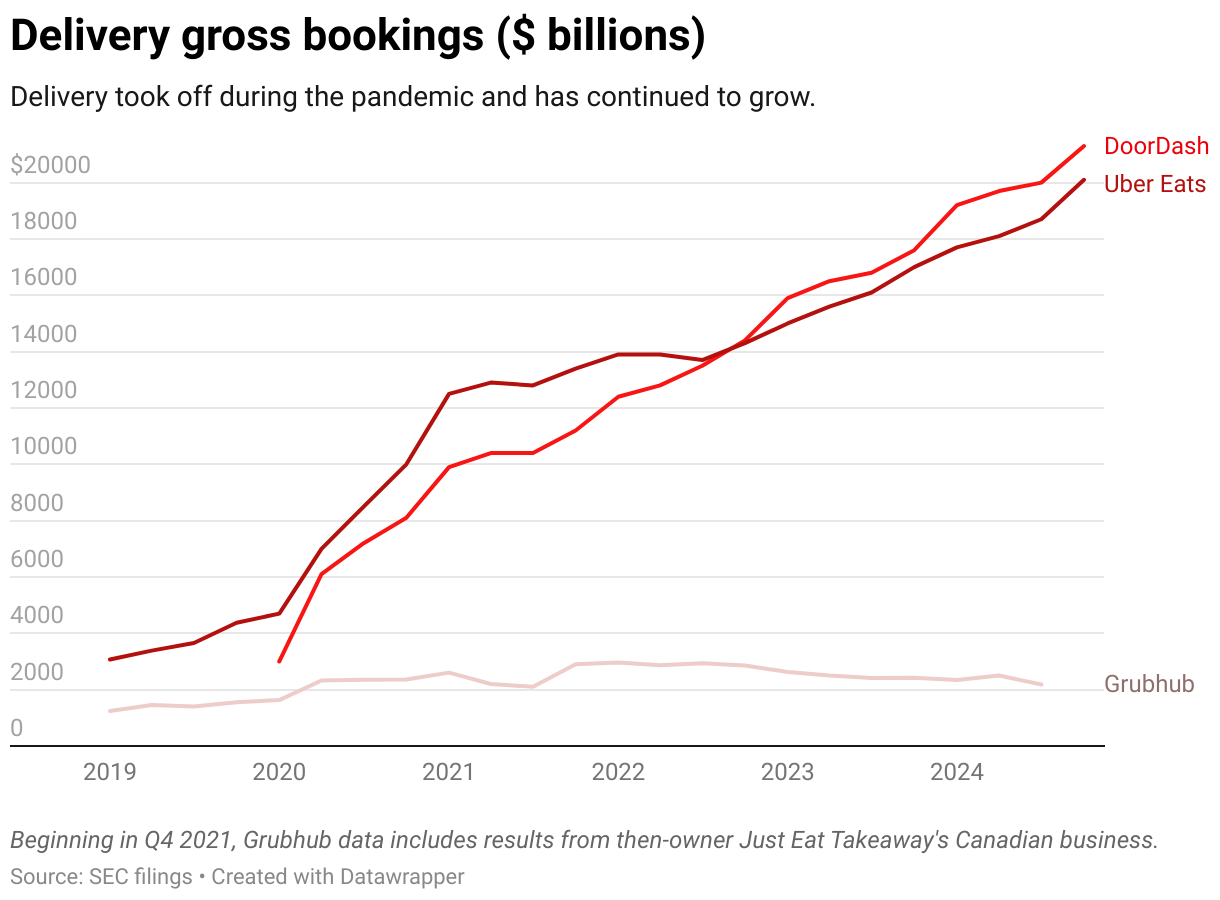
That said, the pandemic only accelerated a trend that was already underway. Delivery had been growing since the early 2010s as companies like Grubhub, Postmates, DoorDash and Uber Eats began to apply the principles of online shopping and gig work to food. Consumers liked the convenience and selection these services offered. Investors, ever on the lookout for the next Amazon, plowed hundreds of millions of dollars into delivery companies. It was undoubtedly an area of growth.
Still, restaurants were not so sure about it. Third-party delivery posed some real issues. It was expensive, for one, with delivery providers keeping a chunk of each sale as a commission. It brought delivery people in and out of the restaurant, which could be disruptive. And perhaps most importantly, it put a wedge between restaurants and their customers.
“I’m not sure that restaurants at that point said ‘This is the future,’ because it stands dead against what a restaurant tries to do, which is embrace its customers, to get to know them, bring them in,” Backman said. “All of that gets negated by delivery.”
The pandemic, of course, gave restaurants little choice but to embrace delivery. And they learned how to make it work. They reassessed their operations, technology and packaging to adapt to the off-premise service model. They renovated their restaurants and parking lots and shrunk their dining rooms. Some added novel formats like virtual brands and ghost kitchens to take advantage of the new channel, or developed seatless prototypes that were designed specifically for delivery and takeout.
“I see delivery as a step on the evolution of restaurants toward a more systematic form of production,” Backman said. “At a holistic, perhaps simple level, it’s turned a restaurant even more into a factory than it was.”
For Denny’s, delivery was not a significant part of its business before the pandemic. But the event opened the diner chain’s eyes to the benefits of the service, which it now views as a strategic advantage.
“Especially for a brand like Denny’s where it was majorly focused on butts in seats in our booths … to give us a chance to shift and differentiate our business I think is cool,” said Dylan Taylor-Smith, the chain’s VP of media and digital strategy.
During the pandemic, Denny’s invested heavily in delivery, developing custom packaging to ensure breakfast staples like eggs and hashbrowns traveled well. It also retrained staff to account for the quickly growing business and to make sure customers had a good, consistent experience.
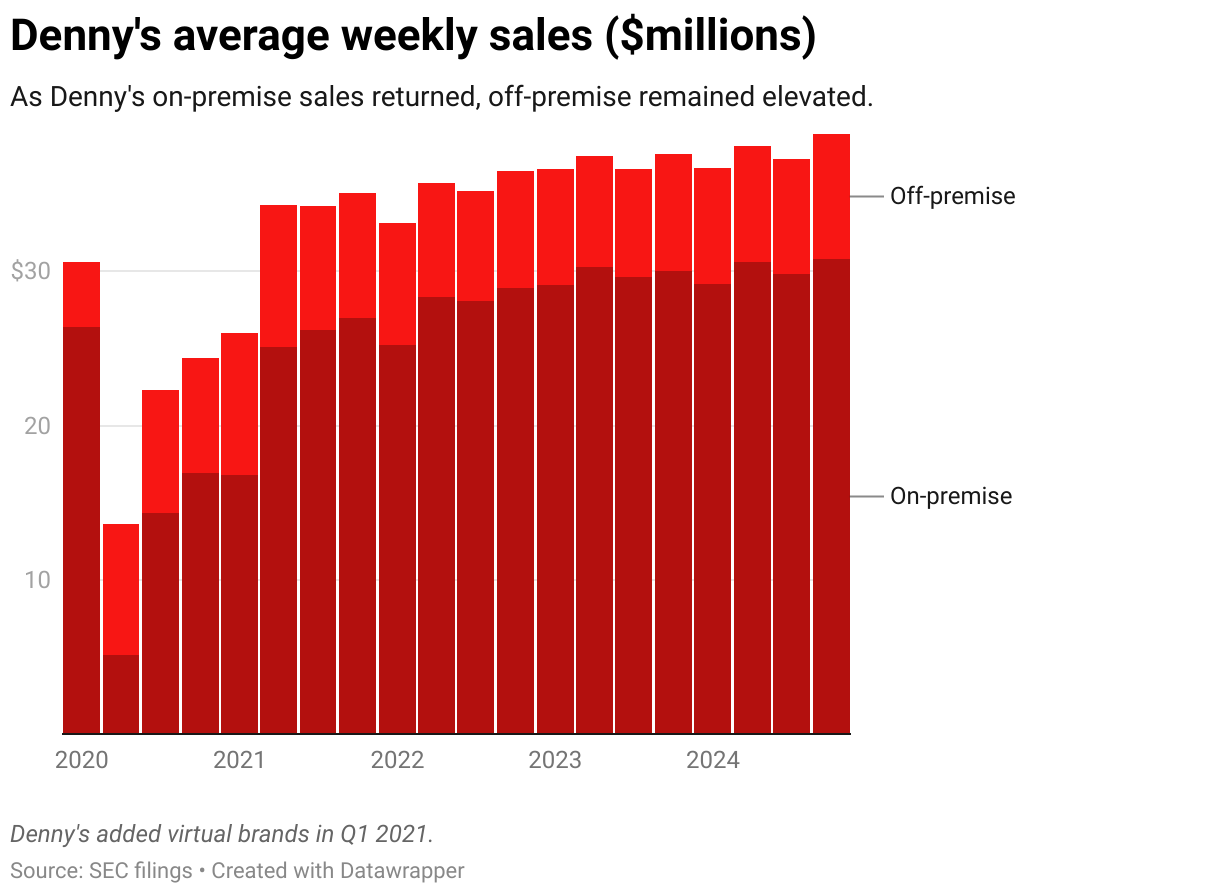
The chain found that delivery gave it access to a whole new set of customers, especially younger people who had never been to Denny’s before.
“That incrementality is something that no one could ever walk away from and should ever walk away from,” Taylor-Smith said.
Denny’s also discovered that delivery fit naturally with its business model. Many of its restaurants are open around the clock, and delivery became something that it could market late at night when most restaurants are closed.
To lean further into that advantage, Denny’s launched three delivery-only virtual brands designed to help drive business during dinner and late-night when its restaurants are less busy.
Today, Burger Den, Banda Burrito and The Meltdown make up just a sliver of Denny’s overall sales, but they do over-index in those later dayparts. And they are highly incremental: There is just 1% of overlap between customers who dine in at Denny’s and customers who use its virtual brands.
Off-premise now accounts for more than 21% of the chain’s total sales, up from 10% to 12% before the pandemic.
Taylor-Smith believes that Denny’s would have gotten to this point with delivery eventually, but the pandemic sped things up.
“The pandemic really forced the issue,” she said. “It just forced some really cool innovation and growth and expansion of brands that really fit our model in ways that doesn’t maybe fit in some other casual-dining players.”
While the growth of delivery has been good for many restaurants, it has not come without its challenges. The new revenue stream introduced fresh economic and operational complexities. And it deepened restaurants’ ties to powerful delivery companies like DoorDash and Uber Eats.
It became common for restaurants to mark up their prices on delivery apps to help offset their commissions, creating frustration for customers and tension with delivery providers. And many operators feel bound by the opaque algorithms that influence their performance on delivery apps. Restaurants of all sizes are still navigating this new landscape.
Even before the pandemic, Crisp Salads, a salad concept with three locations in Portland, Oregon, did a lot of delivery. But it has skyrocketed since 2020 and by the end of last year, third-party delivery alone accounted for 53% of Crisp’s sales.
The problem is, third-party delivery is Crisp’s least-preferred sales channel because of the cost and because it doesn’t get to keep any of the customer data for those orders. Crisp marks up its delivery prices by about 10% to help offset its delivery commissions.
“In my perfect world, people would probably do takeout,” said owner Emma Dye. “Then I’m not paying any commission to anybody.”
Dye has made an effort to get people to use Crisp’s other ordering methods, particularly its own website, where delivery and pickup are offered for a lower price. Staff put postcards in every to-go order encouraging people to do so. But it has been difficult. Crisp’s first-party online ordering sales have actually declined while third-party delivery has grown.
“It’s really hard to convert those folks,” she said of third-party delivery users. “People who have DashPass (DoorDash’s subscription program), they look at DoorDash.”
And yet restaurants have little choice but to participate in the third-party delivery market these days.
“When we think about restaurants, where more and more customers are moving to the delivery model, then not being on the platform becomes a risk,” said Steve Tadelis, an ecommerce expert and professor of economics at the University of California, Berkeley, in an interview last year. “They’re pretty much stuck in a world where this is the new business model.”
Backman noted that up to this point, restaurants have largely viewed delivery companies as antagonists. Restaurants’ interest in hospitality and service do not necessarily align with delivery providers’ focus on technology and rapid expansion, and that has put them at odds.
But, he said, that could change as the market stabilizes and delivery firms turn their focus to sustainable growth. He foresees more cooperation between the two parties as a result.
“Delivery companies need to become closer to restaurants than restaurants need to become closer to delivery companies,” he said. “I think this will have a calming effect on delivery companies and pave the way for a more cooperative environment.”