

Do loyalty programs really work? The whole restaurant industry is wondering. What this week’s column dares to ask is, are they even necessary?
Loyalty programs have become increasingly common in recent years. In a tough economy, restaurants need traffic and customers want deals, and loyalty promises to close the gap. The programs generally are designed to drive visits by dangling carrots such as freebies and discounts in front of customers.
But that strategy has been hounded by a difficult question: Do rewards programs truly generate incremental, profitable traffic? Or are they just a roundabout way of giving free food to people who would have visited anyway?
Some recent data from researcher Circana helps to illustrate this conundrum. Circana looked at receipts from the four biggest restaurant loyalty programs in the U.S. and found that loyalty traffic doubled from 2019 to 2024. That is impressive, but perhaps not that surprising when you consider brands’ efforts to drive loyalty signups over that time, in part by limiting deals and promotions to customers who downloaded their apps.
Circana also found that loyalty members tend to be heavy restaurant users to begin with, and now account for nearly 40% of all restaurant visits. Also impressive, but not necessarily surprising. If you already use restaurants a lot, why not earn some free food while you’re at it?
Ultimately, Circana could not determine how much of the twofold increase in loyalty traffic was due to those heavy users visiting more often than they did before signing up.
“It’s difficult to connect if it’s incremental,” said Tim Fires, president of global foodservice at Circana. “You follow the baseline and see what their behaviors are. But there’s also a lot of macro things that can drive the behavior.”
Circana concluded that loyalty programs can be impactful for restaurants, but not automatically. Programs must be active and engaging to drive participation: Think secret menus, exclusive perks and other features that make customers feel seen.
“It’s not about is it worth having one. It’s what you do with it, how you use it,” Fires said.
Other data, from Technomic, tells a similarly mixed story. Technomic tracks loyalty usage by more than 56,000 consumers, and found that actual redemptions have ebbed and flowed over the years.
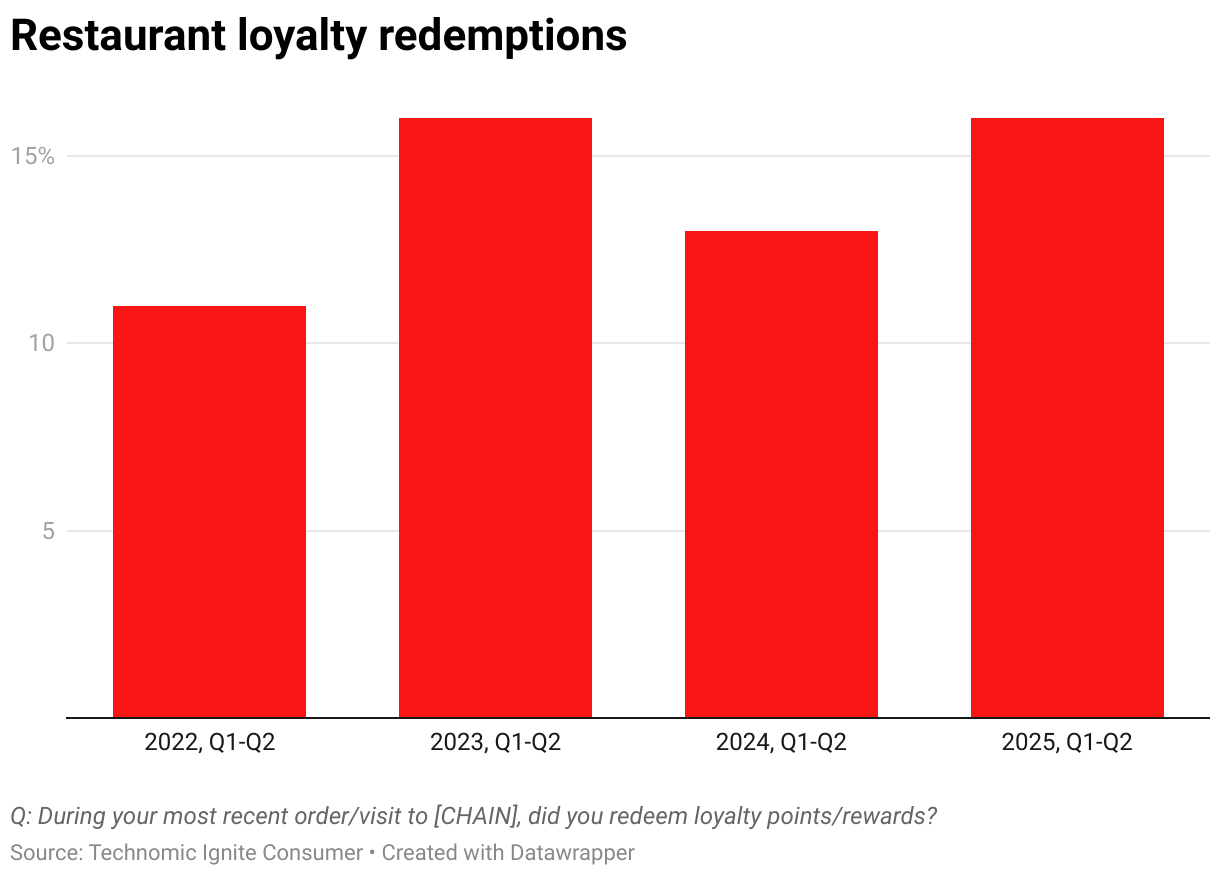
Robert Byrne, Technomic’s senior director of consumer research, said that the fluctuation could have something to do with changes to loyalty programs themselves. Many brands have tweaked how long it takes for customers to earn a reward, for instance, which could be affecting redemption rates.
But the numbers also reflect a more basic truth: Consumers are unpredictable. “Some will simply bail on program rewards or an app, both for no reason and for good reasons,” Byrne said. Hello noise, my old friend.
Throughout my effort to understand what is really going on with loyalty, I keep coming back to McDonald’s and Starbucks. The two biggest U.S. restaurant chains also have the two largest loyalty programs, at more than 150 million globally for McDonald’s and 34 million for Starbucks in the U.S. They should provide a good idea of how loyalty is really impacting the industry.
And believe it or not, the two giants have been struggling for over a year to generate traffic. McDonald’s U.S. sales rose just 0.6% last year, and Starbucks’ declined by 0.5%. The problem has prompted a flurry of promotional activity at McDonald’s (e.g., the return of the Snack Wrap) and a complete overhaul at Starbucks.
Their massive loyalty programs have not been enough to save them, and may have even been hurting their cause. In one of his first moves as CEO of Starbucks last year, Brian Niccol decided that Starbucks needed to focus less on rewards members and more on general customers.
Meanwhile, some brands have done just fine without loyalty programs. The best example is In-N-Out, the West Coast burger chain that grew sales by more than 11% last year, per Technomic, with no rewards to speak of.
In-N-Out, of course, is known for its high-quality, reasonably priced food and fast, friendly service. Customers have responded by visiting more often.
“In-N-Out is already affordable and the food has been consistent for the last 20+ years. That enough is their loyalty program,” wrote one user of the In-N-Out subreddit.
It’s a simple philosophy, but one that stands to reason, and data. According to Technomic, nearly half (49%) of consumers said that when they are deciding whether to visit a restaurant, a recommendation from a friend or family member is the most influential factor. That speaks to a restaurant’s food and overall experience, not its marketing strategy.
To be sure, loyalty programs are still a big factor for some consumers. Twenty-two percent said a restaurant’s loyalty program would influence where they ate, the second most popular choice.
But almost the same amount (21%) cited the importance of online ratings and reviews, while another 21% said special events or promotions, like limited-time offers, can sway their dining decisions.
Taken as a whole, this suggests that while loyalty programs can be a helpful tool, they rank lower in the order of operations than fundamentals like food quality, service, atmosphere and affordability.
Many brands would do well to dial in those things first before jumping on the loyalty bandwagon. It’s already full to bursting anyway, and it looks a little lost.